Video is no longer a marketing channel. It is the medium through which most modern business is conducted. Your prospects research suppliers on YouTube before they call. Your buyers watch a five-second hook on LinkedIn before they decide whether you exist. Your new hires watch your culture video before they accept your offer. Your competitors are already using video to do all of this and more.
This guide is not about making a video. It is about building a system. A purposeful, layered, measurable strategy that puts video to work for your business across sales, marketing, recruitment, operations and brand. You may have one video. You may have a hundred. Either way, what matters is how they fit together and what each one is asked to do.
I wrote the first version of this guide in 2021. The four-phase framework at its core has held up. The world around it has not. Short-form vertical video has reshaped attention. AI has reshaped production. Search has moved off Google and onto YouTube, TikTok and LinkedIn. Buyers now expect to know exactly what working with you feels like before they ever pick up the phone. The 2026 edition rebuilds the guide around those shifts.
Read it once end to end. Then come back to the phase you need.
— Arek
Video is the closest thing to being in the room with someone without being in the room. It carries voice, body language, environment, pace and proof at the same time. Text tells. Photography shows. Video does both, with motion, and adds the dimension of time. That combination is why a two-minute video can do the work of a fifty-page brochure, a one-hour meeting and a stack of references.
The behavioural shift is now permanent. People prefer to watch rather than read. They prefer to be shown rather than told. They expect to be able to evaluate a business by scrolling, watching, listening and watching again before they ever fill out a contact form. If your business is invisible in that pre-purchase research, you are not in the consideration set.
Some current data points worth knowing.
The figures change every quarter. The direction does not.
The original version of this guide assumed a particular media landscape. That landscape has shifted. If you built a video strategy three or four years ago and haven't revisited it, the following will probably feel uncomfortable.
TikTok, Instagram Reels and YouTube Shorts now dominate discovery. Vertical 9:16 video is no longer a social novelty. Any 2026 video plan that ignores it is leaving most of the audience untouched.
Native LinkedIn video reaches decision-makers at a cost and frequency no other platform matches. For B2B and professional services, LinkedIn is now the first organic and paid priority, not Facebook.
iOS privacy changes, rising CPMs and pixel attribution gaps mean Facebook and Instagram are no longer the auto-default outbound channel. They still work, but the math is tighter and the creative bar is higher.
Buyers search on YouTube, TikTok, LinkedIn and through ChatGPT and other AI assistants. Pure Google SEO is now one channel of several. Video performs across all of them.
AI scripting, b-roll, dubbing, translation, avatars, editing and personalisation now exist. Some are genuinely useful. Some are still gimmicks. The line is moving every month.
Loom, Vidyard and Sendspark made it normal for sales reps to record a personalised 90-second video for a prospect rather than send a paragraph of text. Teams that do this convert noticeably better.
Long-form, conversational, multi-cam, clipped down to short verticals. They build authority in a way short-form alone cannot.
More than 80% of social video is watched without sound. A video without burned-in captions is a video that is not watched.
Audiences are more sceptical of polished sales messages and more responsive to founders speaking plainly to camera. The well-shot founder vlog often outperforms a high-gloss corporate piece.
Captions, alt text, content warnings, accurate disclaimers and clear sourcing matter more than they used to, particularly in regulated sectors.
A video strategy built on 2021 assumptions will produce 2021 results.
Three principles sit underneath everything that follows.
Every video should have one job. State what action it is meant to provoke, in whom, at what stage of the buying decision. If you cannot answer that in one sentence, do not film it.
A modestly produced video that is distributed well will outperform a beautifully produced one that is posted once and forgotten. Plan distribution before you plan production.
Treat video as an asset, not a campaign. A campaign ends. An asset earns for years. The VBC we filmed in 2022 still drives leads in 2026 because it was made to compound.
The framework from the 2021 version still holds. We've kept it and expanded each phase to reflect what works now.
| Phase | What it does | Pre-condition |
|---|---|---|
| 1. Full Integration | Make video part of the systems already producing your revenue | You have an existing pipeline |
| 2. Inbound Coverage | Convert the people already searching for you | You have a website and a discoverable presence |
| 3. New Sales Strategies | Open new gateways for revenue | The basics convert |
| 4. Outbound | Reach the people who don't yet know you | All systems downstream are ready |
The order matters. Most businesses skip straight to Phase 4 because it feels exciting. They run ads to a website that doesn't convert, through a sales process that doesn't qualify, with no follow-up sequence in place. The ads "don't work." The ads were never the problem.
Fix the basics first. Each phase compounds the one before it.
There are more than thirty types of video a business can produce. Listing them all in a flat list is the same mistake the 2021 guide made. The better question is: what is each one for, and at what stage of the buyer's journey does it fire?
The funnel below maps the core types to the stage where they do the most work.
The four phases that follow tell you how to deploy these types together as a system, not as standalone pieces.
Most video strategy work fails at this phase because the team would rather make new things than improve the things that already work. Resist that. The integration phase is where the highest ROI is found, because every win lifts revenue that is already flowing.
The single question that drives Phase 1: where in our existing process does a video remove friction, save time, or close a deal faster?
The original guide called this rule number one. It still is.
A prospect who walks into a meeting having seen your Video Business Card arrives warm, qualified, and aligned on what to expect. You skip thirty minutes of background. You spend the meeting on their specifics rather than your origin story. You filter out time-wasters who never watch.
How to operationalise it:
The benefit compounds over years. A team of five people, doing five first meetings a week, each saving fifteen minutes, recovers about three working weeks per year of senior time.
Every email your business sends is a distribution opportunity. The signature is the cheapest, longest-running ad placement you own.
The signature placement quietly drives more video views than most paid campaigns. Set it once. Refresh it once a year.
This is the single biggest addition since 2021. It deserves its own block.
A 1:1 sales video is a 60 to 120-second video recorded by a salesperson, for a specific prospect, often with a hand-written name card or screen tour. Tools: Loom, Vidyard, Sendspark, BombBomb, or a webcam recording shared via Google Drive.
Set the standard. Every salesperson on your team should be able to record a personalised video within five minutes of a meeting ending. The teams that do this consistently outperform the teams that don't.
Map your website and your existing client journey. Mark every page or moment where a decision is made. These are the points where a video lifts conversion the most.
For each, ask: what video would reduce hesitation here? It might be the VBC. It might be a 30-second testimonial. It might be a founder addressing the specific concern that comes up at that moment.
The rule: never let a major decision happen in silence.
Often overlooked, often the fastest payback.
Internal video does not generate leads directly. It removes load from your team so the team can do the work that generates leads.
If your team is growing, this category will quietly become one of the most valuable video stacks you own.
Inbound is the most efficient lead source any business has, because the audience is pre-qualified. Someone who types "video production Melbourne" into Google or YouTube has already done the hardest part of the sales work. The only job left is to be there, look credible, and make the next step obvious.
This phase is about defensive coverage of every place a prospect might land on their way to you.
Before you create new pages, fix the existing ones.
Use Google Analytics, Hotjar, Microsoft Clarity or similar to find:
For each leaking page, design a video with one specific job. Place it at the friction point. Re-measure.
A landing page with a strong video above the fold typically lifts conversion by 30-80% over the same page without one. The exact lift varies, but the direction is reliable.
Google is no longer the only search engine that matters.
Your video should be designed once, then deployed differently for each surface. A two-minute interview can be cut into a five-minute YouTube long-form, six 30-second LinkedIn clips, twelve 15-second vertical Shorts and a square Instagram post. Same shoot. Different surfaces.
Short-form is increasingly used as a search interface, especially by younger buyers. Three principles:
A short-form video that ranks for a search query keeps earning for months.
A landing page is a single-purpose page designed to convert. The 2021 guide covered this and it still holds. Two additions for 2026.
Conversion-rate optimisation is now a continuous practice, not a one-off. Tools like Unbounce, Webflow, Framer and even native page builders make it cheap to test variants. Run two versions of the page, change one variable, measure for two weeks, keep the winner.
Video must work without sound. The autoplay-muted convention means the first impression of your hero video is silent. Bake in burned-in captions, a clear on-screen text overlay of the headline, and a strong first frame. If your video is only watchable with sound on, you have lost the majority of viewers before they decide to unmute.
Avoid: long menus, multiple competing CTAs, autoplay sound, walls of text without a video to break them up.
Your social profiles have "sticky" positions that almost no one uses well. Use them.
This is set-and-forget work that compounds for years. Audit once a quarter.
Testimonial videos should not live on a "Testimonials" page that no one visits. They should appear at the exact moment a prospect needs reassurance.
A 30-second clip of a happy client saying "we were nervous about the cost but it paid back in three months" placed next to your pricing block does more work than a hundred logos on a generic trust page.
This is how testimonials should be deployed. Not in a gallery. In the flow.
Phase 3 is where most of the upside lives. The integrations are in place. The website earns its keep. Now we use video to create revenue streams that did not exist before.
Phase 2 covered the page for the search term you most want to win. Phase 3 expands the footprint.
For each adjacent keyword cluster, build a dedicated landing page with its own video, its own headline and its own call to action. Do not redirect them all to the home page. Each landing page is a fresh entry point optimised for the specific intent of the searcher.
Example: a video production agency might have separate landing pages for corporate video Melbourne, training video production, recruitment video, video for trades businesses, and video for ECE centres. Same business. Different doors. Each door optimised for the people knocking on it.
This is the cleanest scalable lever for inbound growth.
Sometimes you cannot take more clients. Either you're full, or seasonal demand is wrong, or the prospect is not ready to commit.
The default move is to lose the lead. A better move is to capture it.
A Waiting List page is a single-purpose page that says: We're at capacity. Join the list. We'll email you when we open up. Here's a video on what to expect. Embed the VBC. Capture name, email, and the rough timeline they're looking at.
Ask the question: what could we sell directly from the website right now, without a meeting, that a video could pre-sell?
For each, build a short video that explains what it is, who it's for, what's included and what happens next. Place a payment button immediately under the video. This is the closest a business can get to revenue while they sleep.
This was missing from the 2021 version. It shouldn't have been.
A live webinar or recorded masterclass is the highest-trust top-of-funnel video format in B2B. Forty to sixty minutes of genuine value, ending with a clear offer. People who finish a webinar are dramatically warmer than people who finished a sales page.
A single evergreen webinar funnel can carry a business for years. It also produces enormous amounts of repurposable short-form content.
A relatively new lever and an underused one. A video podcast is a long-form, multi-cam conversation recorded with intent to be clipped, distributed and indexed.
For Fifth Castle Media clients, the video podcast is increasingly the centrepiece of an annual content plan, with everything else feeding off it.
Outbound used to mean cold calls and direct mail. Today it means short-form video, paid social, PR, partnerships, referrals and personalised cold video. Everything downstream from the click must already be ready. If it isn't, go back to Phase 1, 2 and 3 first.
Press still works, especially in regional media, trade press and sector-specific publications. Journalists are time-poor. A press release that arrives with a ready-to-use 90-second video and a folder of stills is dramatically more likely to be picked up.
For a video, keep it under 90 seconds, with broadcast-safe captions and a clean handover frame at the end so editors can cut to their own outro.
The cheapest, highest-leverage outbound move available, and the most underused.
Identify three to five non-competing businesses that serve your ideal customer. Approach each with a video that explains who you are and proposes a specific collaboration: a joint webinar, a shared content series, a referral arrangement, a co-sponsored event, a podcast swap, a bundled offer.
A short personalised video attached to a partnership pitch closes at multiples of the rate of an emailed pitch alone.
In 2026, for most professional services, B2B and commercial businesses, LinkedIn is the highest-leverage video channel by a wide margin.
This is the channel I would prioritise for almost every commercial business in 2026.
If LinkedIn is the priority for B2B, short-form vertical is the priority for B2C and most consumer-facing businesses. Often both.
The three platforms are TikTok, Instagram Reels and YouTube Shorts. The same vertical asset can run on all three. The behaviours are different but not different enough to require three production tracks.
Frequency: three to five per week is the typical floor. The platforms reward consistency. The good news is that one shoot day can produce a month of clips if planned well.
The 2021 guide treated this as Facebook and Instagram. Today it's a portfolio.
| Platform | Best for | Typical creative format |
|---|---|---|
| YouTube pre-roll | Awareness at scale, B2C and considered B2B | 15s skippable, 6s bumper |
| YouTube in-feed | Discovery, mid-funnel | 30-60s horizontal |
| Meta (Facebook + Instagram) | Retargeting, lookalike audiences, B2C | 15-30s vertical and square |
| LinkedIn ads | B2B account-based marketing | 30-90s vertical or square |
| TikTok ads | B2C and increasingly B2B for younger audiences | 15-30s vertical, native style |
| Spotify / podcast pre-roll | Audio-led awareness | 30s audio, sometimes video |
| Google Demand Gen | Cross-channel YouTube + Discover + Gmail | Multiple formats |
Don't outsource ads to whoever filmed the video. Ad media buying and creative production are different disciplines. Bring in a specialist for media. We'll be the people who make the creative actually work.
The original guide treated referrals well and the principles still hold. The update is to make the toolkit more usable.
Send this to your top 30 referrers once a year. Ask them to keep it somewhere they'll find it. Don't make them think. Don't make them remember your phone number. Make sending the referral a two-tap action.
A small but powerful bonus: thank referrers publicly when their referral closes. A short video saying "thanks to X for sending Y our way" reinforces the behaviour and signals to others that you notice.
The last big addition for 2026. The cold-video-in-an-email approach has gone from novel to expected in many B2B sales motions.
Open rates and reply rates for this approach typically run 5-10x a templated cold email. The trade-off is time. The trade-off is worth it for high-value targets.
Do not use AI avatars to fake personalisation in this format. Buyers can tell. It damages trust permanently.
Every shoot should be designed to produce many assets, not one. The pyramid is how we think about it.
The maths is striking. One well-planned interview day can produce:
If you are filming once and producing one video, you are leaving most of the value on the floor.
Plan the pyramid before the shoot. Brief the interviewer to ask questions that will produce stand-alone clips. Capture b-roll that suits both horizontal and vertical framings. Record clean audio that can be lifted out for the podcast cut. Take stills during the shoot.
This is the difference between a video that costs you money and a video library that earns you money.
AI is now part of video production. Pretending otherwise is unhelpful. Buying into the hype uncritically is worse. The honest position is to know where AI helps, where it hurts, and where the human bar is still rising faster than the machine.
The agencies that win in 2026 are the ones that use AI to take the friction out of production and pour the saved time into craft. Not the ones that use AI to make more, faster.
Some craft principles do not change. Some have changed substantially. Both matter.
For any video that represents the brand publicly, the floor is:
Below this floor, video can still work for internal use and 1:1 sales video. Above this floor, video starts compounding as a brand asset.
The 2021 guide said "use Google Analytics." That's no longer sufficient. A modern video measurement stack has three layers.
What the video itself did.
Tools: YouTube Studio, Vimeo, Wistia, Vidyard, LinkedIn analytics, Meta Insights.
What viewers did next.
Tools: GA4, Hotjar, Microsoft Clarity, your CRM.
What the business earned.
This is the hardest layer to measure and the most valuable. It requires CRM integration, multi-touch attribution and patience. It is where the budget conversations are won.
You do not need every metric. For most businesses, the meaningful dashboard is:
Review monthly. Trend over quarters. Decisions based on noisy weekly data are usually wrong.
The hardest thing to measure is also the most important. Strong video, distributed well, compounds.
A great Video Business Card filmed today will earn for five to ten years. A useful YouTube tutorial published this quarter will rank for years. A LinkedIn video posted this week will be referenced by a prospect six months from now.
The compounding return is the largest part of video's ROI, and the part most businesses fail to count.
A short list of the failure patterns we see most often.
Filming first and asking "what do we do with this?" after is the most expensive way to make video. Decide the job before the shoot.
A single video forced to do brand work, sales work, recruitment and explainer work usually fails at all of them. Each video should have one job.
A video posted once is a video almost no one saw. The distribution plan is half the strategy.
No captions, no on-screen text, no visual storytelling. Most viewers don't unmute. The video doesn't land.
Spending on cameras while filming with a phone microphone. Audio is the first thing to spend on. Always.
Polish is not the point. Story is the point. The most-shared video in your sector this year is probably less polished than yours, and more useful.
The filmmaker is not the brand. The brand is the brand. Brief properly.
Testimonials belong at decision points, not in a gallery.
Don't.
Phase 4 before Phase 2 means burning money to learn lessons you could have learned for free.
The single biggest predictor of B2B video success is whether the founder or operator is willing to show up. If you won't be on camera, your competitor who will is at an advantage you cannot make up with production value.
Video is a habit, not an event. The businesses that pull ahead are the ones with a sustainable monthly or quarterly cadence, not the ones that produce one glossy hero piece every two years.
AI-narrated explainer videos, AI avatars, AI-faked personalisation. Easy to make. Easy to detect. Damaging when found out.
A video strategy that isn't measured cannot improve. Even rough numbers are better than none.
Video is a cross-functional asset. Sales, marketing, recruitment, training, operations and customer success should all be at the table.
Fifth Castle Media is a Melbourne-based video and photography production agency. We help organisations build complete video systems that work for sales, marketing, recruitment and internal communication.
We take care of it all on three critical fronts.
First, let us discover all the ways purposeful videos can help your organisation. From marketing, sales and educational content through to recruitment and training. The long-term strategy sets you up for success in every area of your business and adapts as you grow.
We work smart. We take care of the pre-production and planning so you can focus on your business. We organise the right crew and create content that engages your audience, pre-qualifies your clients and positions you as the leader in your field.
Our services don't end at delivery. We want to see you succeed and assist with implementation, optimisation and metrics for your new content. That way the videos keep working for you and you can see the results.
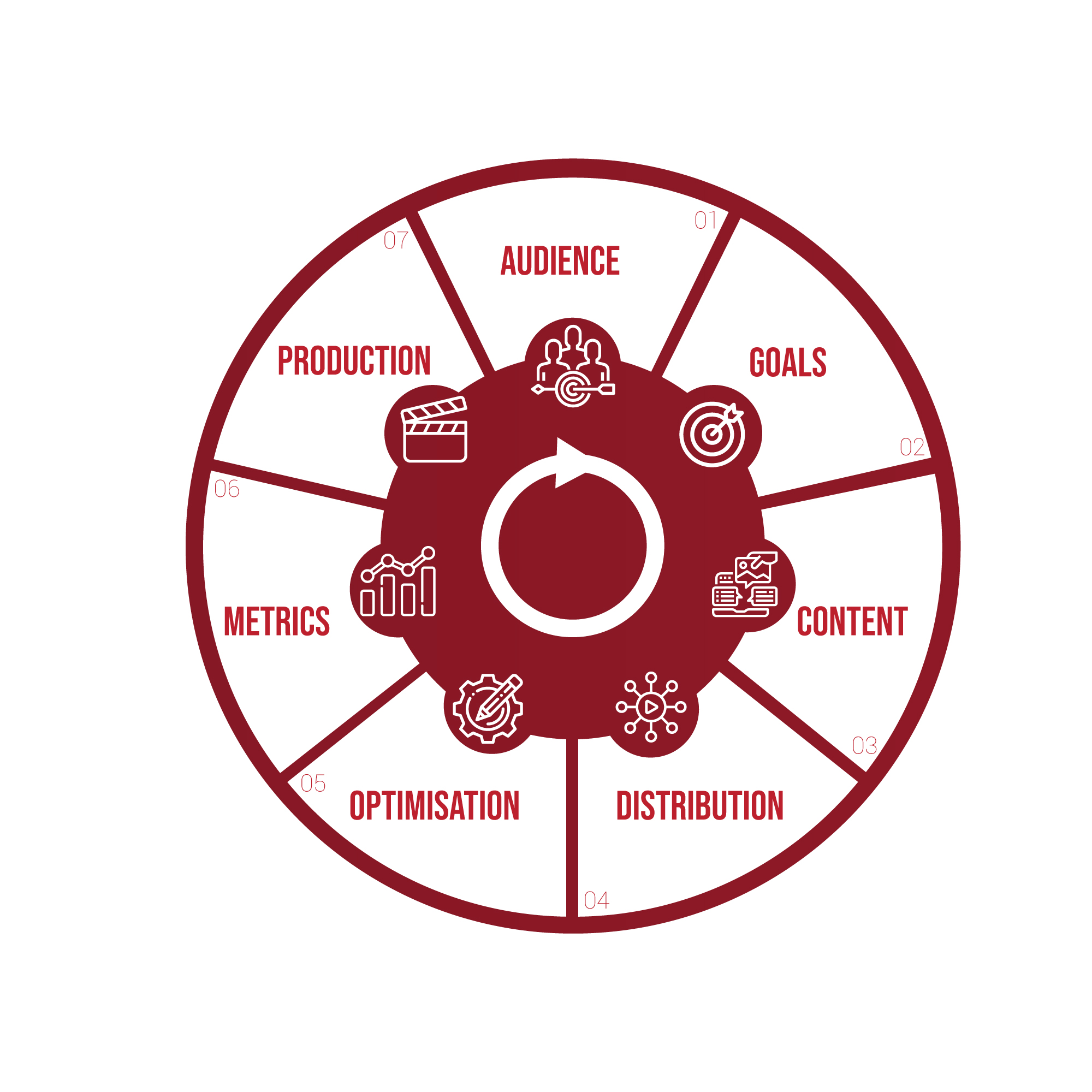
Every project moves through the same cycle. Audience, goals, content, distribution, optimisation, metrics, production. Then back to audience. It is a system, not a sprint. The longer we run it together, the more it compounds.
| Phase | Focus | Deliverables |
|---|---|---|
| Discovery | Strategy and planning | Twelve-month video roadmap, shot list, distribution plan, measurement plan |
| Foundation | Foundation production | Video Business Card, two or three core supporting assets |
| Integration | Putting video to work | Implementation across website, CRM, sales process, email signatures, social profiles |
| Expansion | Layered production | Testimonials, short-form content, ad creative, training content |
| Compounding | Ongoing cadence | Production rhythm, optimisation, measurement, refresh |
Projects are scoped to the work, not the calendar. A typical engagement sits between $4,000 and $15,000 per project, depending on production volume, complexity and the breadth of strategy and implementation support included.
We are deliberately not the cheapest. We are usually the most useful.
There's a Video Business Card on the homepage. Watch that first, then book a call. As the guide above suggests, we won't take a meeting unless you've watched it.